Key Takeaways
- The US-China tech competition centers on strategic technologies with dual civilian-military applications
- Recent policy shifts include aggressive export controls, domestic manufacturing incentives, and competing innovation ecosystems
- Third-party nations face mounting pressure to align their technology ecosystems with either the US or China
- Supply chain vulnerabilities and technological interdependence create complex security challenges
- Future scenarios range from complete technological decoupling to limited cooperation in specific domains
The US-China technology competition has profound implications for global security and international relations
The Current Technological Landscape
The technological competition between the United States and China has intensified dramatically in recent years, with both nations implementing aggressive policies to secure advantages in critical domains. This rivalry extends across multiple technological frontiers, each with significant implications for global security and economic development.
Key Technology Battlegrounds
Artificial Intelligence
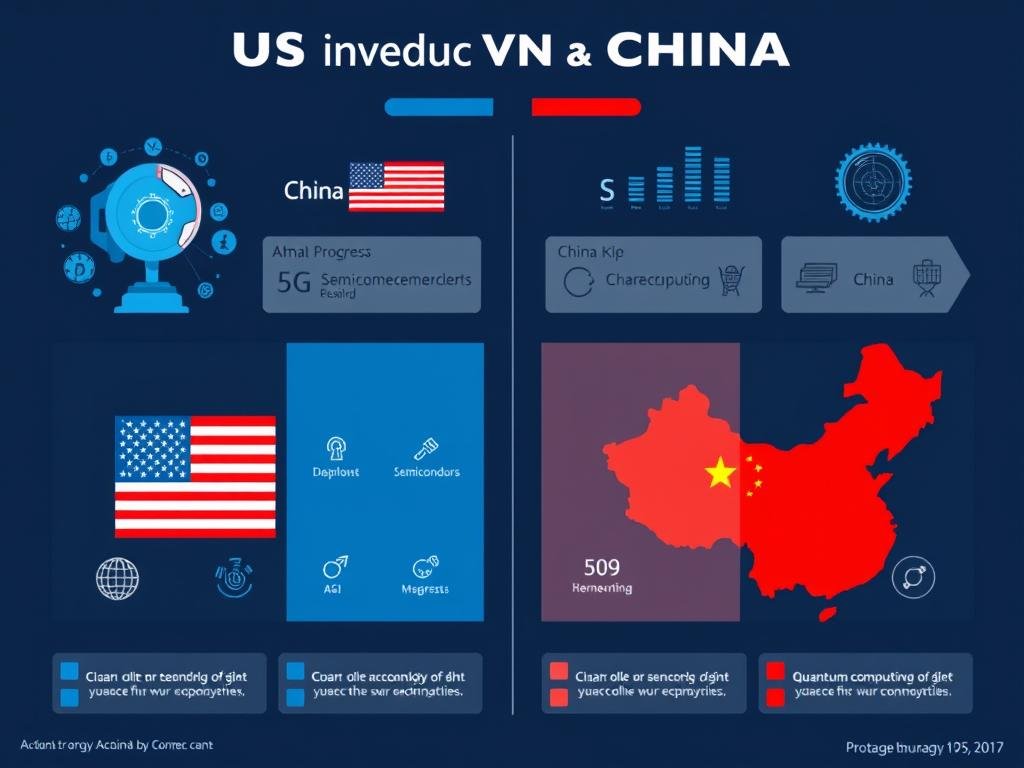
While the US maintains leadership in fundamental AI research and commercial applications, China has made remarkable progress through its national AI strategy. The US leads in algorithm development and research talent, but China excels in data collection, facial recognition, and surveillance applications. Both nations recognize AI as a transformative technology with profound military and economic implications.
Semiconductors
The US and allies like Taiwan, South Korea, and Japan dominate advanced semiconductor manufacturing, with companies like TSMC, Samsung, and Intel leading in cutting-edge chip production. China remains heavily dependent on imported chips despite massive investments in domestic capabilities. Recent US export controls targeting China’s semiconductor sector have significantly impacted Beijing’s technological advancement timeline.
Quantum Computing and 5G
In quantum technologies, the competition remains relatively balanced, with both countries making significant investments. Meanwhile, China has taken an early lead in 5G deployment through companies like Huawei, prompting US-led security concerns and restrictions. The battle for 6G standards is already underway, with potential for completely bifurcated telecommunications ecosystems.
Recent Policy Developments
United States Approach
- The CHIPS and Science Act (2022) providing $52.7 billion for domestic semiconductor manufacturing
- Comprehensive export controls targeting China’s access to advanced semiconductors and manufacturing equipment
- Executive orders restricting US investment in Chinese technology sectors
- Formation of technology alliances like the US-EU Trade and Technology Council
- Increased scrutiny of academic and research collaboration with Chinese entities
China’s Response
- $1.4 trillion investment in “new infrastructure” including AI, 5G, and quantum technologies
- Anti-sanctions laws and “unreliable entity list” to counter US restrictions
- Dual Circulation Strategy emphasizing technological self-sufficiency
- Military-Civil Fusion strategy integrating civilian innovation with defense applications
- Digital Silk Road initiative expanding Chinese technology standards globally
“The defining global competition of the twenty-first century is the U.S.-China technology race. Beijing’s explicit ambition is to displace the United States as the world’s technological and economic superpower, viewing dominance of advanced industries as key to this goal.”
Analyzing Security Risks
The technological competition between the US and China creates multifaceted security challenges that extend beyond traditional military concerns to encompass economic security, critical infrastructure protection, and digital sovereignty.
Dual-Use Technologies and Military Applications
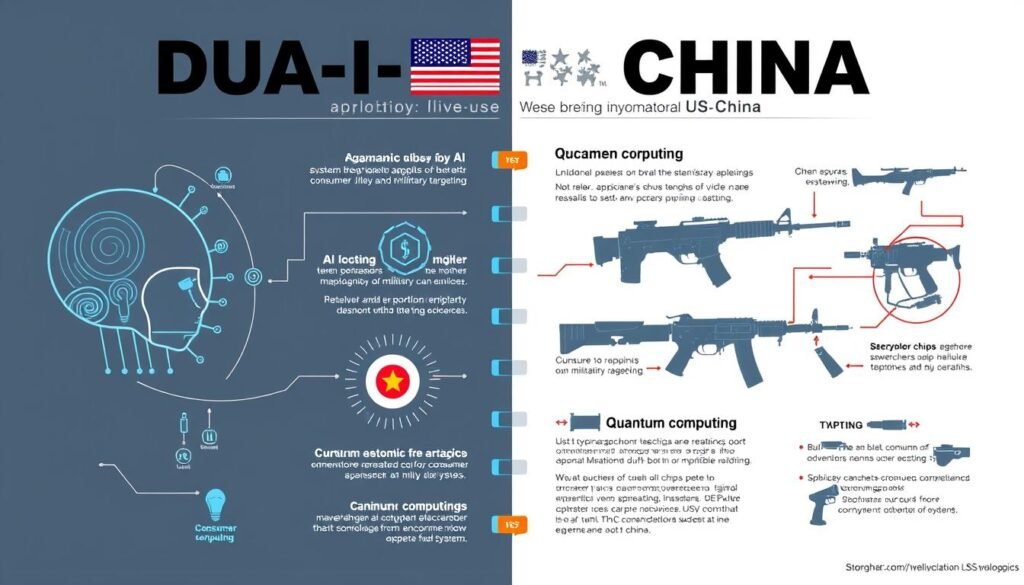
Many of the technologies at the center of US-China competition have significant dual-use applications, serving both civilian and military purposes. Artificial intelligence systems developed for commercial applications can be repurposed for autonomous weapons, surveillance, and military decision-making. Quantum computing threatens to break existing encryption standards while enabling new forms of secure communication. This dual-use nature complicates export control regimes and raises the stakes of technological leadership.
| Technology | Civilian Applications | Military/Security Applications | Strategic Significance |
| Artificial Intelligence | Consumer services, healthcare diagnostics, autonomous vehicles | Autonomous weapons systems, intelligence analysis, cyber operations | High – potential to revolutionize warfare and intelligence |
| Quantum Computing | Drug discovery, climate modeling, financial optimization | Breaking encryption, secure communications, sensor improvements | Very High – could neutralize existing security systems |
| Advanced Semiconductors | Consumer electronics, data centers, automotive | Advanced weapons systems, military communications, surveillance | Critical – foundational to all modern military systems |
| 5G/6G Networks | Enhanced mobile broadband, IoT connectivity | Battlefield communications, command and control systems | High – enables network-centric warfare capabilities |
Supply Chain Vulnerabilities
The globalized nature of technology supply chains creates significant security vulnerabilities that both the US and China are working to address. The semiconductor industry exemplifies these challenges, with production spanning multiple countries and companies, creating potential points of failure or compromise.
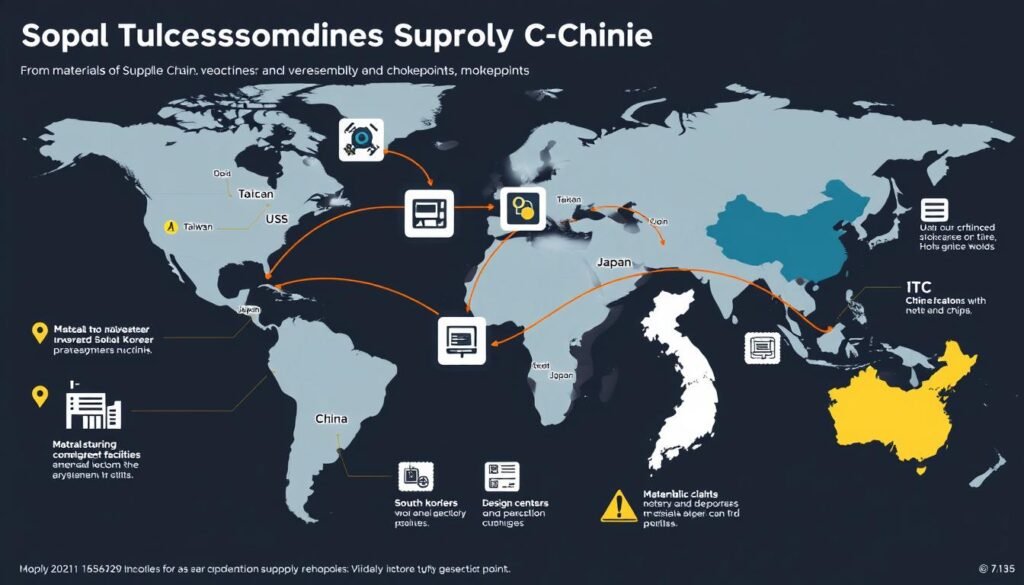
Recent disruptions—from the COVID-19 pandemic to geopolitical tensions—have exposed the fragility of these global supply chains. Both the US and China are pursuing strategies to reduce vulnerabilities, with the US focusing on “friend-shoring” critical production to allied nations while China accelerates its drive for technological self-sufficiency. These parallel efforts are reshaping global supply networks and creating new security dynamics.
Case Study: Huawei and 5G Infrastructure
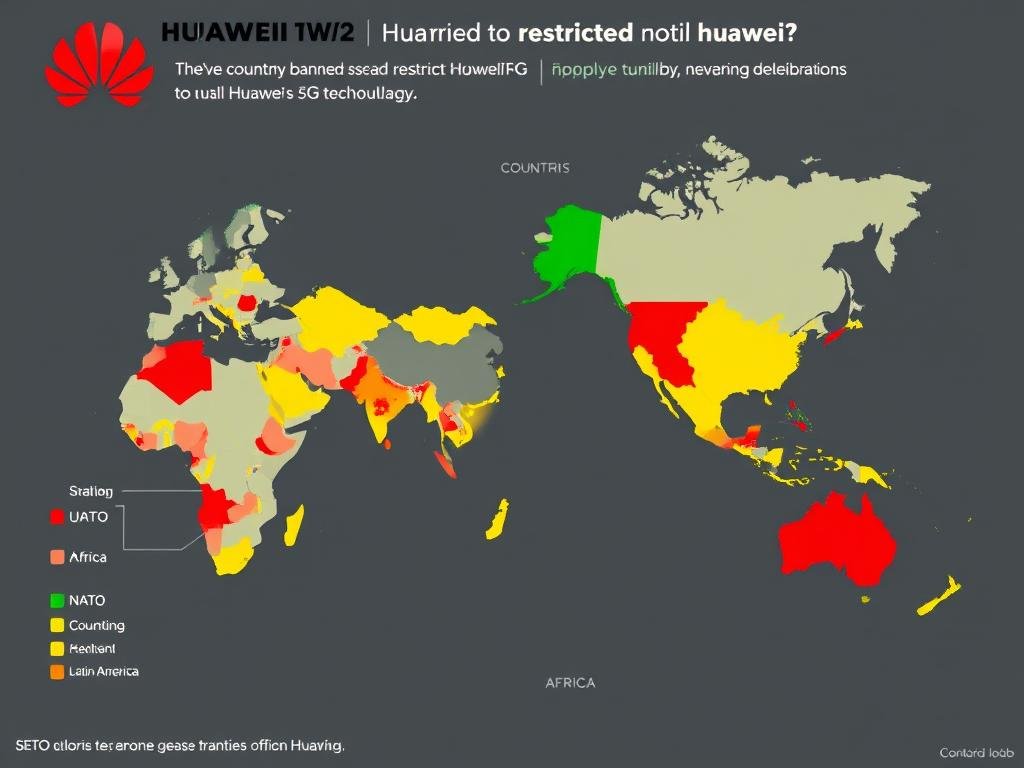
The global debate over Huawei’s role in 5G infrastructure development provides a compelling case study of how technology competition impacts security decision-making. The United States led a campaign to exclude Huawei from 5G networks in allied countries, citing national security concerns about potential backdoors and the company’s relationship with the Chinese government. This campaign resulted in varying responses across NATO and partner nations:
- The UK initially allowed limited Huawei participation but later reversed course, banning the company from its 5G networks
- Germany adopted a risk-based approach with enhanced security requirements rather than an outright ban
- Australia and Japan implemented early restrictions on Chinese telecommunications equipment
- Many developing nations continued Huawei deployments, balancing security concerns against cost advantages and existing relationships
This case illustrates how technological choices increasingly reflect geopolitical alignments, with countries forced to balance security considerations against economic factors and diplomatic relationships.
Global Implications of the Tech Competition
The US-China technology competition is reshaping the global order, forcing countries worldwide to navigate complex choices about digital infrastructure, research partnerships, and regulatory frameworks.
The Challenge for Third-Party Nations
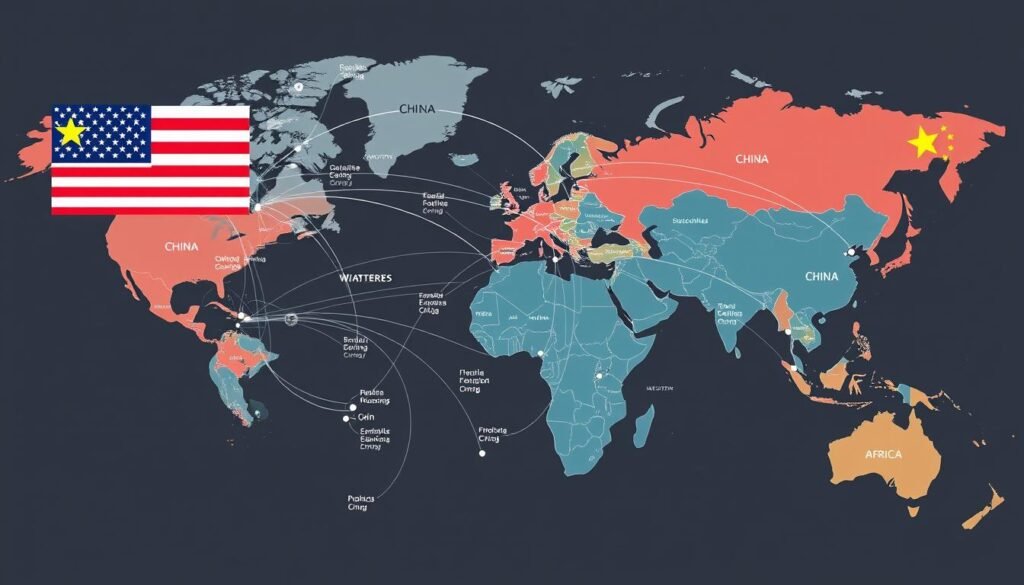
Countries around the world increasingly face pressure to align their technology ecosystems with either the United States or China. This creates particular challenges for nations with significant economic ties to both powers, such as those in Southeast Asia, Europe, and Africa. Strategic responses vary widely:
Strategic Alignment
Some nations have clearly aligned with one technological sphere. The United Kingdom, Australia, and Japan have largely embraced US-led technology standards and security frameworks, while countries like Cambodia and Pakistan have deepened integration with Chinese digital infrastructure.
Strategic Hedging
Many countries attempt to maintain relationships with both powers while preserving autonomy. India exemplifies this approach, participating in US-led technology initiatives while maintaining independent policies on issues like data localization and digital sovereignty.
Digital Non-Alignment
A growing number of nations are pursuing digital non-alignment strategies, developing independent capabilities and regulatory frameworks while selectively engaging with both US and Chinese technology ecosystems based on specific national interests.
Risks of Bifurcated Technology Ecosystems
The intensifying competition raises the prospect of a bifurcated global technology landscape with separate US-led and China-led ecosystems. This technological fragmentation would have profound implications:
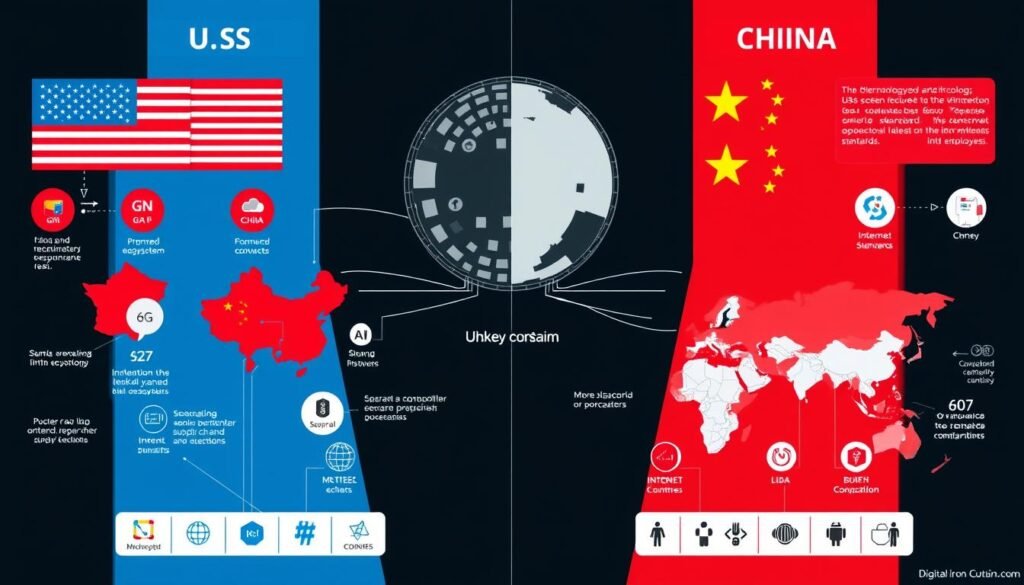
- Increased costs for businesses operating across both ecosystems
- Reduced efficiency in global innovation due to duplicated efforts
- Incompatible standards limiting interoperability and global collaboration
- Heightened security risks from fragmented governance frameworks
- Uneven access to technologies in developing regions forced to choose sides
The Role of Emerging Players
While the US-China dynamic dominates headlines, other significant players are shaping the global technology landscape and security environment:
European Union
The EU has emerged as a regulatory superpower through frameworks like GDPR and the Digital Markets Act. These regulations influence global technology development by establishing standards that companies must meet to access European markets. The EU’s “third way” approach aims to balance innovation with values like privacy, fairness, and democratic oversight.
India
As the world’s largest democracy and a growing technology power, India plays an increasingly important role in shaping global technology governance. Its approach to data sovereignty, digital identity systems, and technology regulation offers an alternative model that balances development needs with security considerations.
Technology Alliances
New multilateral groupings like the Quad Tech Network, the US-EU Trade and Technology Council, and the Global Partnership on Artificial Intelligence are creating alternative forums for technology governance outside traditional institutions, reflecting the growing intersection of technology and geopolitics.
“America’s strength is its innovation that can flourish in a culture that values freedom, diversity, transparency, and equality. These democratic values are inherent to the American identity.”
Expert Perspectives on the Technology Competition
The US-China technology competition has generated diverse perspectives from security analysts, policy experts, and industry leaders. These viewpoints help illuminate the complex dynamics at play and potential paths forward.

Competing Narratives
US “Democratic Tech” Perspective
- Technology development should reflect democratic values like transparency, privacy, and human rights
- Open innovation ecosystems produce more sustainable and ethical technological progress
- Security concerns about Chinese technology are legitimate given the lack of separation between companies and the state
- International cooperation among democracies can create better technology governance frameworks
China’s “Development-First” Perspective
- Technology should prioritize economic development and practical applications over abstract values
- Western concerns about Chinese technology are primarily about maintaining technological hegemony
- Different countries should be free to develop technology governance models suited to their own contexts
- US restrictions on technology transfer represent “technological containment” rather than legitimate security measures
Security Community Assessments

Leading security think tanks and research institutions have offered nuanced assessments of the technology competition’s implications:
“The US-China tech competition is not just about market dominance but about whose values will shape the future of technology. This competition will determine whether advanced technologies reinforce or undermine democratic norms and institutions.”
“The growing technological competition between the United States and China risks creating new security vulnerabilities even as both sides seek greater security through technological advantage. Managing this paradox requires new approaches to arms control, confidence-building measures, and crisis stability in the digital age.”
“Until the U.S. changes capital market incentives to reward longer-term, domestic investment, there is an even stronger need for the government to invest in R&D and incentivize production to ensure leadership in advanced industries.”
These expert assessments highlight the multidimensional nature of the competition, encompassing economic, security, and values-based considerations that defy simple characterization or policy responses.
Future Scenarios and Policy Implications
The trajectory of US-China technology competition remains uncertain, with multiple possible futures that would have dramatically different implications for global security and prosperity.
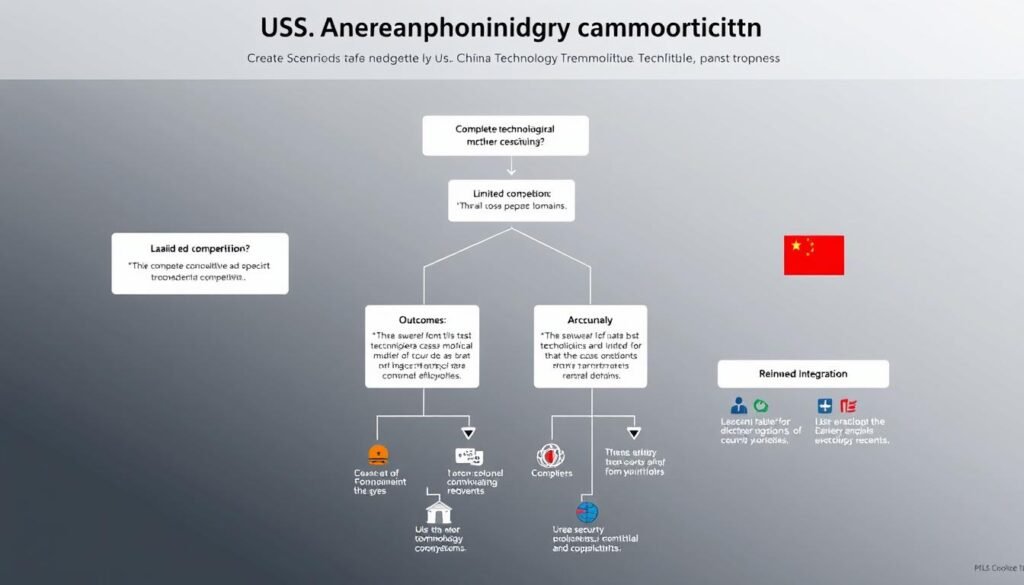
Potential Trajectories
Complete Technological Decoupling
In this scenario, US-China technology ecosystems become fully separated, with incompatible standards, segregated supply chains, and minimal cross-border data flows. Third countries are forced to choose sides, creating a bifurcated global technology landscape that mirrors broader geopolitical divisions.
Security Implications: Heightened risk of misunderstanding and conflict due to reduced communication channels; accelerated military applications of technology; increased cyber operations across technological boundaries.
Managed Competition
The US and China establish limited rules of engagement in technology competition, maintaining some interdependence while competing aggressively in strategic sectors. Selective export controls and investment restrictions coexist with continued scientific exchange in non-sensitive areas.
Security Implications: Reduced risk of catastrophic conflict through maintained communication channels; continued security competition in key domains; selective cooperation on global challenges like climate change and pandemic response.
Multilateral Technology Governance
International institutions develop effective frameworks for managing technology competition, establishing shared standards for responsible innovation and deployment. The US, China, and other stakeholders accept constraints on certain activities in exchange for greater predictability and stability.
Security Implications: Enhanced global cooperation on shared technological threats; reduced risk of unintended escalation; more equitable distribution of technology benefits across developed and developing nations.
Recommendations for Multilateral Governance
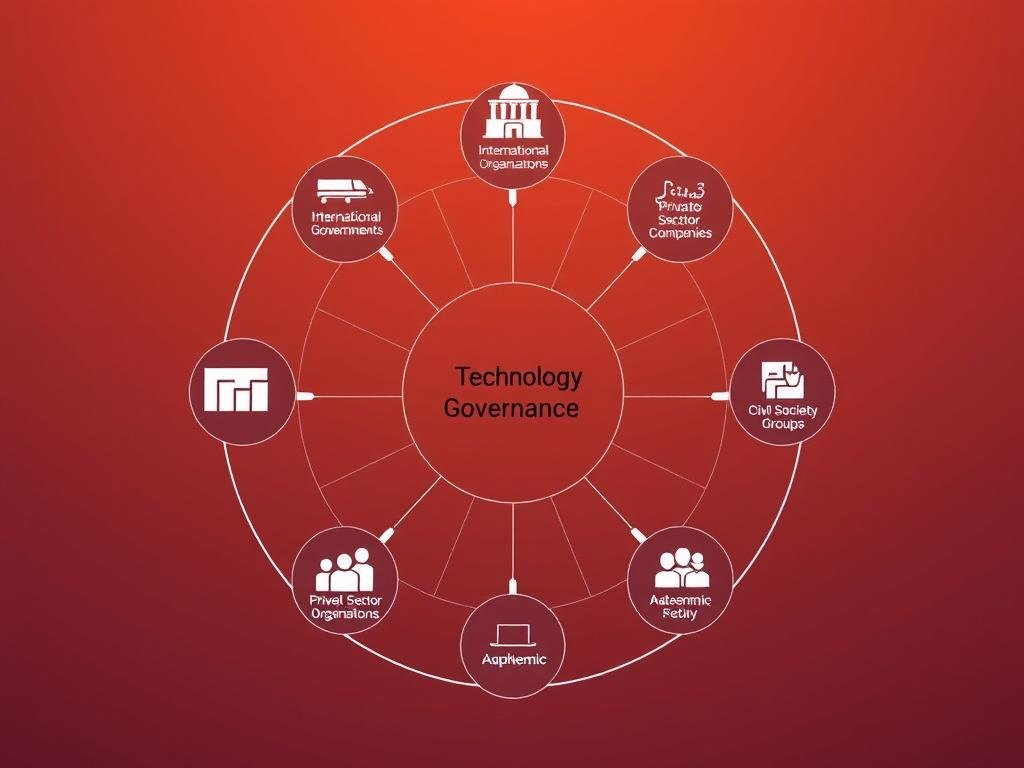
Regardless of which scenario emerges, strengthening multilateral governance frameworks for technology will be essential for managing security risks and maximizing benefits. Key elements of such frameworks might include:
- International standards for AI safety and ethical use, building on existing initiatives like the OECD AI Principles
- Confidence-building measures for cyber operations, including improved attribution mechanisms and crisis communication channels
- Shared principles for securing critical technology supply chains against disruption and compromise
- Agreements on limiting certain military applications of emerging technologies, similar to arms control regimes for conventional weapons
- Collaborative approaches to global challenges like climate change, pandemic response, and food security that leverage technological capabilities from all nations
Conclusion: Navigating the Complex Future
The US-China technology competition represents a defining feature of 21st-century international relations with profound implications for global security. As both nations pursue technological advantage, the choices made by governments, companies, and international institutions will shape not only the balance of power between these competitors but also the broader international order.
Effective responses must balance legitimate security concerns with the benefits of continued innovation and collaboration. Complete technological decoupling would impose enormous economic costs while potentially increasing security risks through reduced communication and understanding. Yet unconstrained technological competition without guardrails could accelerate destabilizing military applications and exacerbate existing inequalities in access to critical technologies.
The most promising path forward lies in developing robust multilateral governance frameworks that can manage competition while preserving cooperation on shared challenges. Such frameworks must engage not only the US and China but also the EU, India, Japan, and emerging technology powers to be truly effective and legitimate.
Questions for Policymakers
- How can nations balance legitimate national security concerns with the benefits of continued technological exchange and collaboration?
- What governance frameworks could effectively manage competition in sensitive technologies while enabling cooperation on global challenges?
- How should smaller and developing nations navigate the increasing pressure to align with either US or Chinese technology ecosystems?
- What role should private sector entities play in shaping technology governance given their central role in innovation?
- How can the international community ensure that advanced technologies benefit humanity broadly rather than exacerbating existing inequalities?
Stay Informed on Global Technology Security
The US-China technology competition continues to evolve rapidly, with significant implications for global security, economic development, and international relations. Subscribe to our newsletter for regular updates, expert analysis, and in-depth reports on this critical issue.